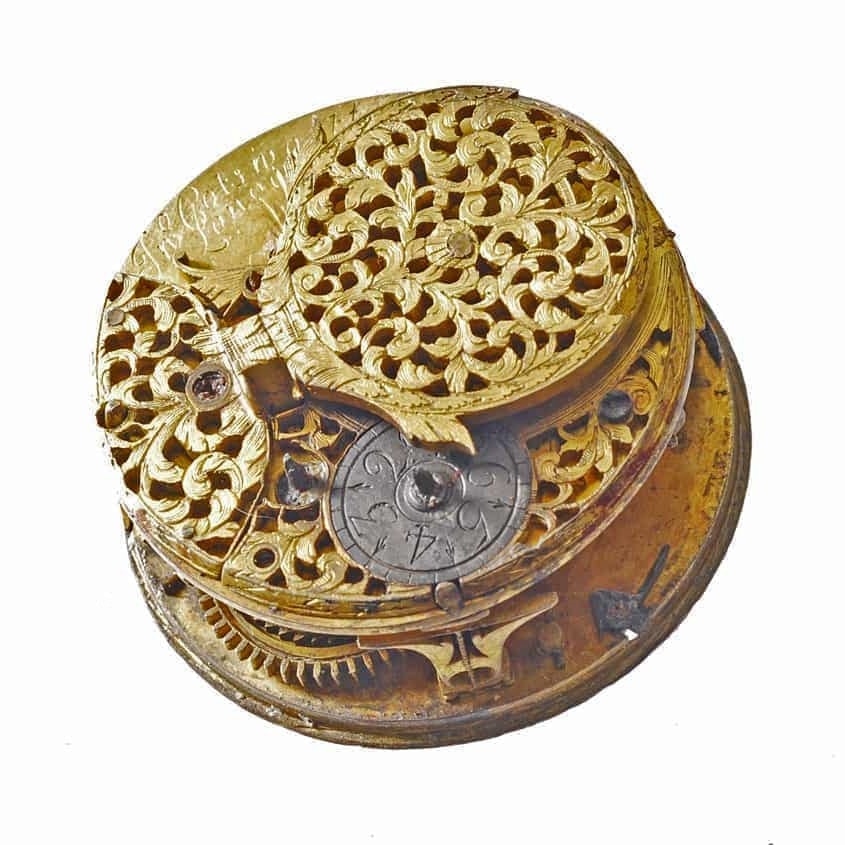
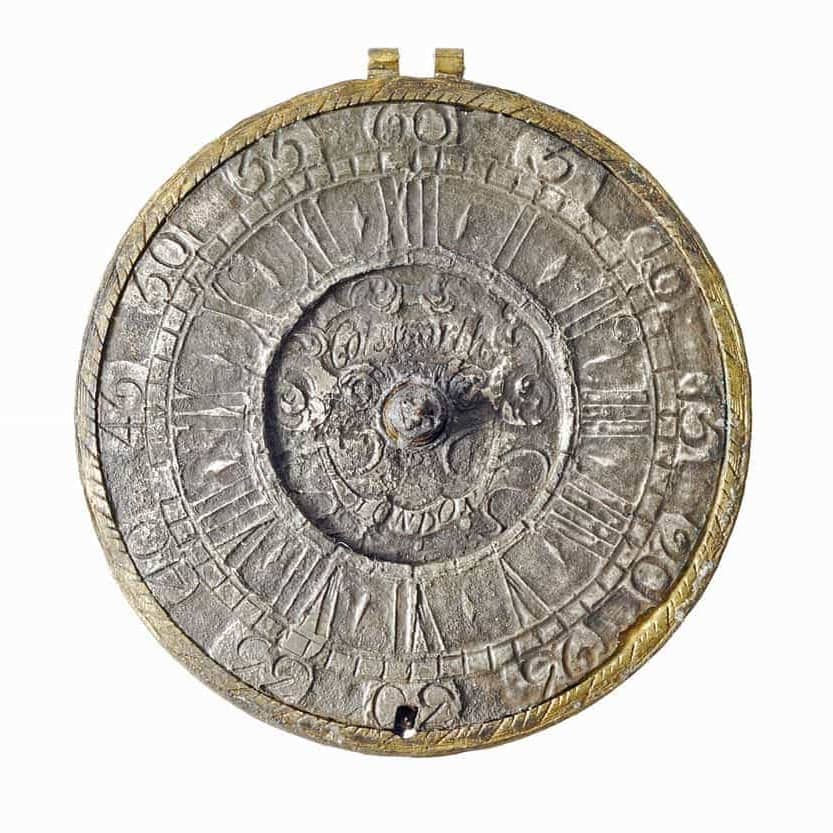
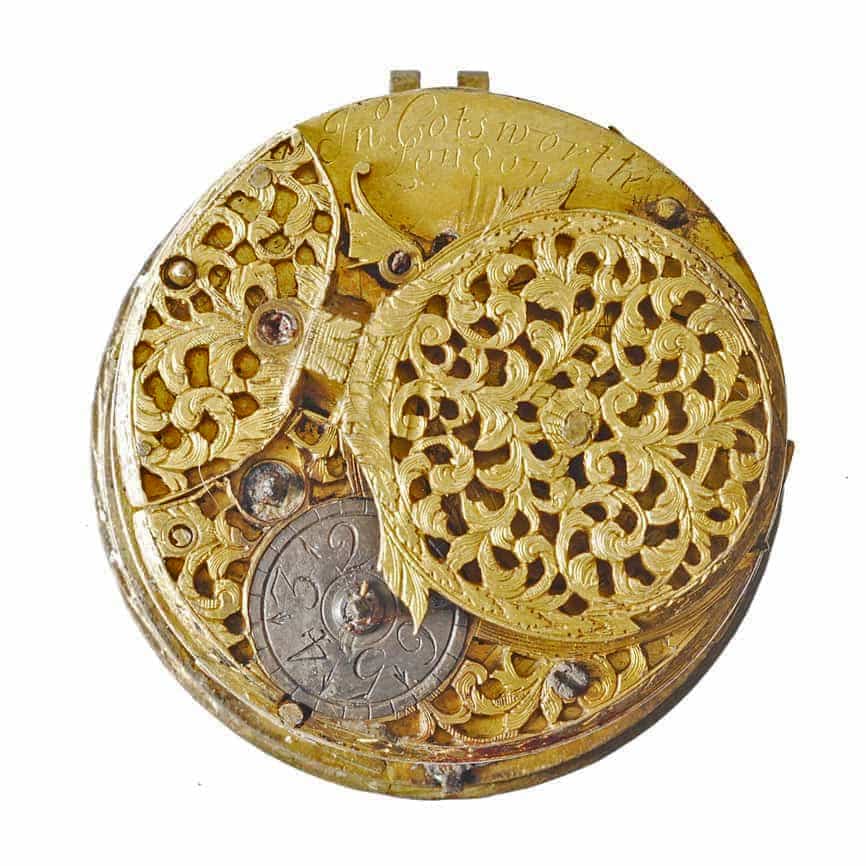
Pocket watch, John Cotsworth, London (1637-1732)
Description
Pocket watch made by John Cotsworth, London (1637−1732), found in a cesspit during an excavation at the New Townin Gorinchem (2009)
John Cotsworth was a clock and watchmaker in London. He worked in Fleet Street and lived to be nearly a hundred years old. His clocks and watches are still sought after by collectors today.
Education
John Cotsworth was born in 1637. His name is sometimes also spelled Cossworth. He apprenticed with Nicholas Coxeter and then with the renowned clockmaker Jeremy Gregory. On July 5, 1669, he became a member of the Clockmakers' Company, the guild of clockmakers in London. From that moment on, he was allowed to have his own workshop. He was probably also an engraver. He may have learned that from Jeremy Gregory, who came from the guild of goldsmiths.
Workshop in Fleet Street
Cotsworth had his workshop in Fleet Street, in the parish of St. Dunstan's-in-the-West. In 1698, he rented a shop next to the church, at Clifford's Inn Lane, for 13 years. On his clocks, he sometimes placed his address: 'John Cotsworth in Fleete Streete'. In 1723, he swore allegiance to the English King. In that list, he is listed as 'Watchmaker, Fleetstreet'. Between 1674 and 1694, Cotsworth trained five apprentices. The most famous was Edward CrouchHe became an apprentice to Cotsworth in 1682. In 1719, he became Master, the highest position in the Clockmakers' Company.
Clocks and watches
Cotsworth manufactured various types of timepieces:
- Grandfather clocksthat run for a month without needing to be wound. An example is a walnut clock with inlay from the late 17th century.e century.
- Table clocksin a cabinet of red tortoiseshell or with marquetry. That is inlay work of various types of wood. The back plate is often decorated with engraved tulips and leaf tendrils.
- Pocket watcheswith a verge movement (spindle escapement) and two silver cases, made around 1700. They are signed 'Jno. Cotsworth, London'.
Oldest resident of the parish
John Cotsworth died in 1732, probably aged 95. When he died, he was described as 'aged near 100, formerly a watchmaker in Fleet Street and the oldest inhabitant of St. Dunstan's Parish'. In his will, he left £50 to each of his two grandsons. They were the sons of his daughter Elizabeth.
Sources
- Bonhams, grandfather clock by John Cotsworth
- Toovey's, table clock by John Cotsworth
- Cogs and Pieces, pocket watch by John Cotsworth
- London Westminster and Middlesex Family History Society, Oaths of Allegiance 1723
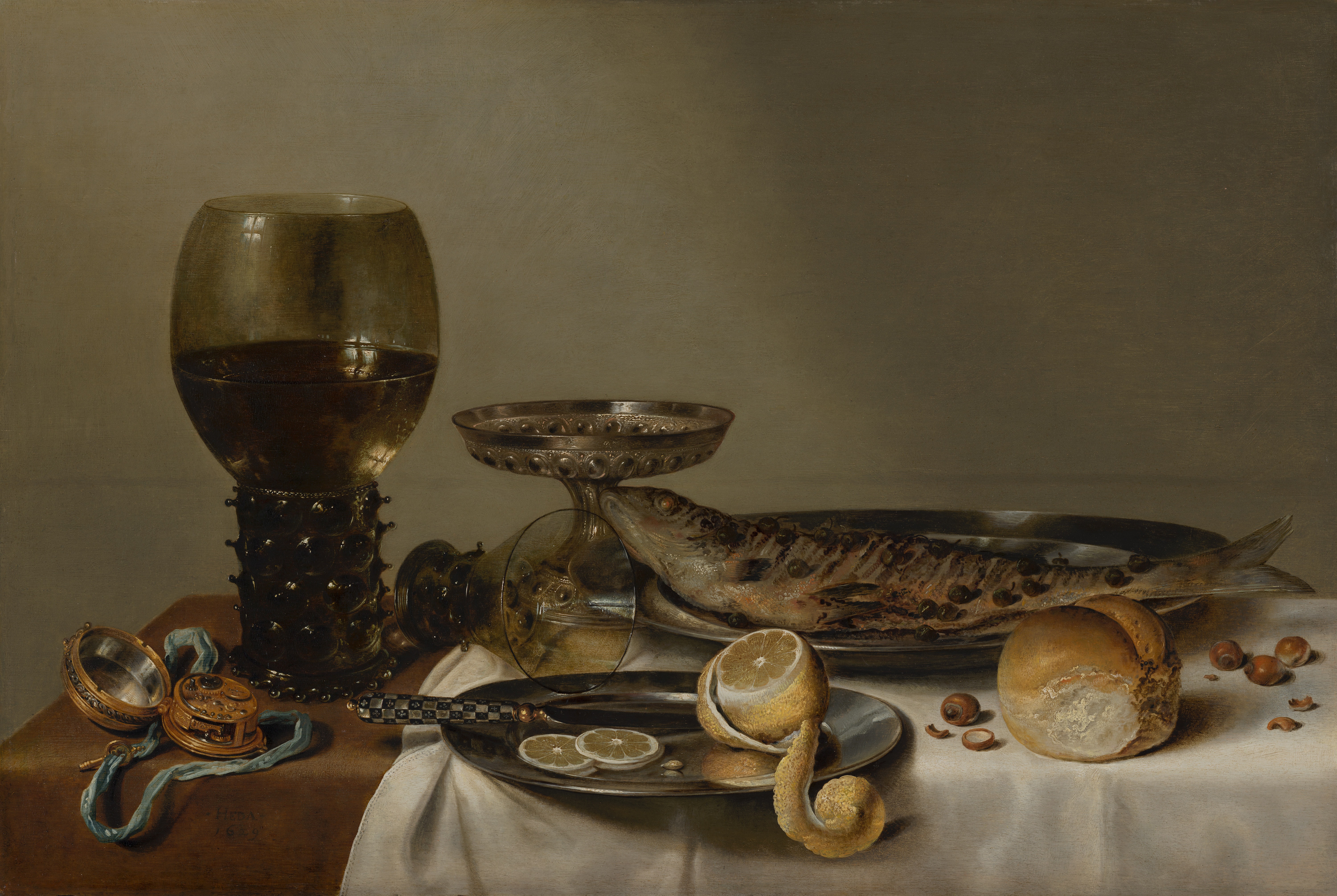
Willem Claesz Heda, Still life with watch (1629)
Details
| Description: | Zakclock Front: around the hand axis: COTHSWORTH LONDON Reverse: Jo COTSWORTH LONDON |
| Material: | Copper alloy |
| Production: | England, London, John Cothsworth |
| Dating: | 1669-1732 |
| Dimensions: | 4 x 2 cm (diameter x thickness) |
| Website: | Gorinchem, Nieuwstad 7a t/md (2009) |
| Find number: | 32745V45-m03 |
| Questions? | Do you see an error? Or do you have additional information about this find? Let us know! |
Site
| Archis number(s): | Case Identifiers: test trenches: 2222691100 (32072) excavation: 2227398100 (32745) |
| Topographic Map: | 38G |
| Coordinates: | 126.320/426.755 |
| Toponym: | Nieuwstad 7a to d |
| City: | Gorinchem |
| Local authority: | Gorinchem |
| Province: | Zuid-Holland |
| Type of research: | IVO-P and DO |
| Executor: | Hollandia Archaeologists |
| Project Manager: | S. Dautzenberg |
| Client: | Construction company J. van Daalen |
| Competent authority: | Municipality of Gorinchem |
| Start of investigation: | 26-11-2008 (IVO-P), 6-1-2009 (TH) |
| Finds & documentation: | Municipal depot for archaeology Gorinchem |
| IN: | https://doi.org/10.17026/dans-zrz-brmt |
Documentation
 |
Hoogendijk, T. (2009) Gorinchem | New Town, in: Archaeological Chronicle of South Holland 2009 41, p. 11-16. flipbook | PDF (5,61 MB) |
 |
Hoogendijk, T. (2011) Inventory field research by means of test trenches (IVO-P) and an archaeological excavation (AO), Gorinchem Nieuwstad 7 a/md, Hollandia series 333, Zaandijk. flipbook | PDF (31,69 MB) |
 |
Hoogendijk, T. (2011) Discarded household effects of a lieutenant colonel, in: Western home 60, p. 314-317. flipbook | PDF (1,14 MB) |
 |
Hoogendijk, T. (2018) Richly filled cesspits on the Kazerneplein and on the Nieuwstad, in: F. Cerutti, R. Mulder, B. Stamkot & A. de Vries (eds.), Ten centuries of Gorinchem. History of a Dutch city, Utrecht, p. 240-241. WorldCat |
| Material: | Copper alloy |
| Period: | New Age B:1650-1850 AD |
| Application: | Personal property |
| Website: | Nieuwstad 7a t/md (2009) |