


GORINCHEM – Just before the 'construction holidays', the infrastructure of the city of Gorinchem is still being worked on. Road users must take into account work on the Spijksedijk, Buiten de Waterpoort, Blijenhoek, Keizerstraat, the western Wolpherensedijk and the Stationsweg. The most striking is the project around the Barracks Square.
The Kazerneplein is being prepared for the construction of an underground parking garage with approximately 400 spaces and the construction of approximately ninety homes. The renovation of the sewerage system has already started in the Torenstraat, the Pompstraat and Smakheul will follow later in the summer.
A drastic consequence of this for the corner of the Struisvogelstraat and the Torenstraat is, especially for the older Gorcumer, the demolition of the old adjutant's house and the felling of the beautiful weeping willow and the Judas tree, unique to this region. Dozens of fish also lost their lives when the adjacent canal was pumped dry on Monday.

Kazerneplein with the former adjutant's house in the foreground
For the work around the Kazerneplein, the one-way traffic system through the city centre has been changed. Depending on the work, traffic will be diverted via routes through the Westwagenstraat or over the Kazerneplein. From mid-July, the square will be closed as a parking lot. The paving and planting will be removed before the construction holidays.
The vacant site of the former Den Haan has now been developed as an alternative parking area. 224 paid parking spaces have been temporarily marked out here. A temporary connection for car traffic is being constructed directly in front of the Wolpherenwal and pedestrians will have their own access to the Den Haan site from the Wolpherenwal.
Barracks Square
If it were up to the municipality of Gorinchem, the first residents would be able to move into their homes on the Kazerneplein in the spring of 1999. According to the planning, the construction of the two-storey underground parking garage would start in the second week of October. This should be ready in November 1998. The construction of the homes would start in May 1998. The municipality has applied for a 'declaration of no objection' from the province and expects to be able to issue the building permit to project developer and construction Ballast-Nedam in September. The construction plan for the Kazerneplein consists of 'connected' homes along the Pompstraat. In the inner area, shops and homes have been drawn around a large square with 'green' play areas.
First, (amateur) archaeologists will have time from August to dig around in the ground, looking for remains of the seventeenth-century Paffenrode estate. A request has been submitted to the Gorcum board of mayor and aldermen to provide a credit of 70 thousand guilders. This amount will probably be taken from the 'urban renewal' fund.
It was not until the end of the sixteenth century that the current Kazerneplein came to lie within the city walls. Four centuries ago, cows still grazed on this piece of land outside the then city. In 1590, Grand Pensionary Adriaan van Weresteyn bought this terrain to build a colossal house and lay out a garden to match. The pleasure garden was sold by the heirs in 1618 to Jonker Jacob van Paffenrode, the city's bailiff (highest administrator). The marble grave monument of his wife Wilhelmina van Arkel can still be viewed in the Gorcums Museum.
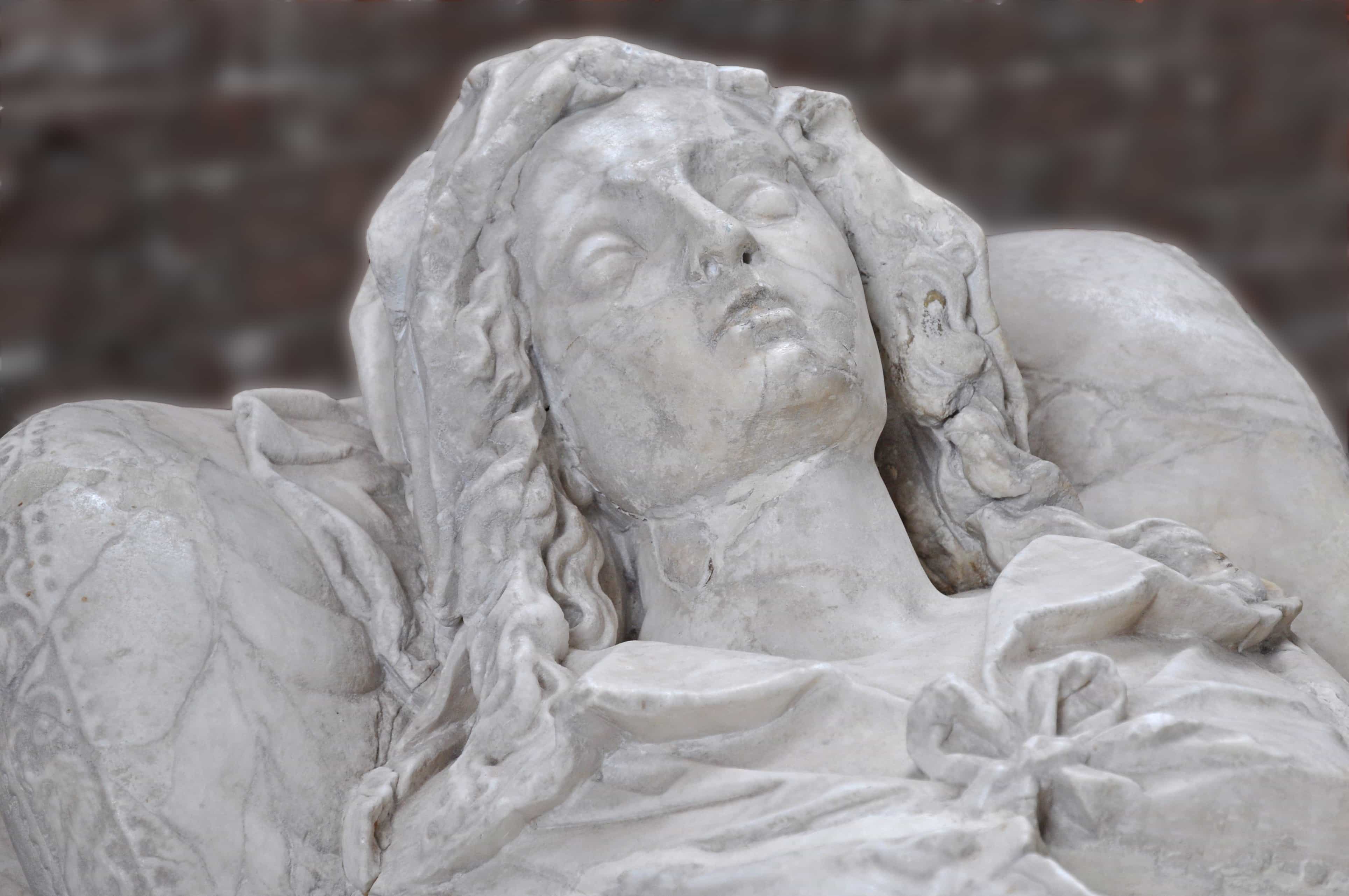
Detail of the grave monument of Wilhelmina van Arkel (±1595 – 1628)
The house was demolished, probably in 1756, and the garden was devalued to building and gardening land. In 1826 the municipality became the owner and built the Willemskazerne there, followed by the Citadelkazerne and various outbuildings. These disappeared in 1969. The adjutant's house held out the longest, it was the last to collapse this month.
From 11 August to 6 September, members of the Archeology working group can enthusiastically work on the research. Interested parties can follow this work from behind the fence, but can also roll up their sleeves themselves. Anyone who wants to help can report to the City Archives at Molenstraat 17 (tel. 0183 – 65292).
Den Haan
When the Kazerneplein is completed in 1999, construction of apartments and houses on the Den Haan site will begin. The famous architect Ralph Erskine from Sweden, who designed the entire plan on behalf of Ballast Nedam, has been asked to work out the sketches for the Den Haan site. The preliminary plans are expected in September and will then be presented to local residents and other interested parties. Any responses will be included in the final plan if possible, the municipality promises in advance.
According to the municipality, the last homes were completed at the end of 2002. In total, 245 new homes have appeared in this part of the city centre, plus approximately 1700 square metres of space for offices and shops.
The total investment amounts to more than one hundred million guilders.
July 9, 1997
Gorcumse Courant